


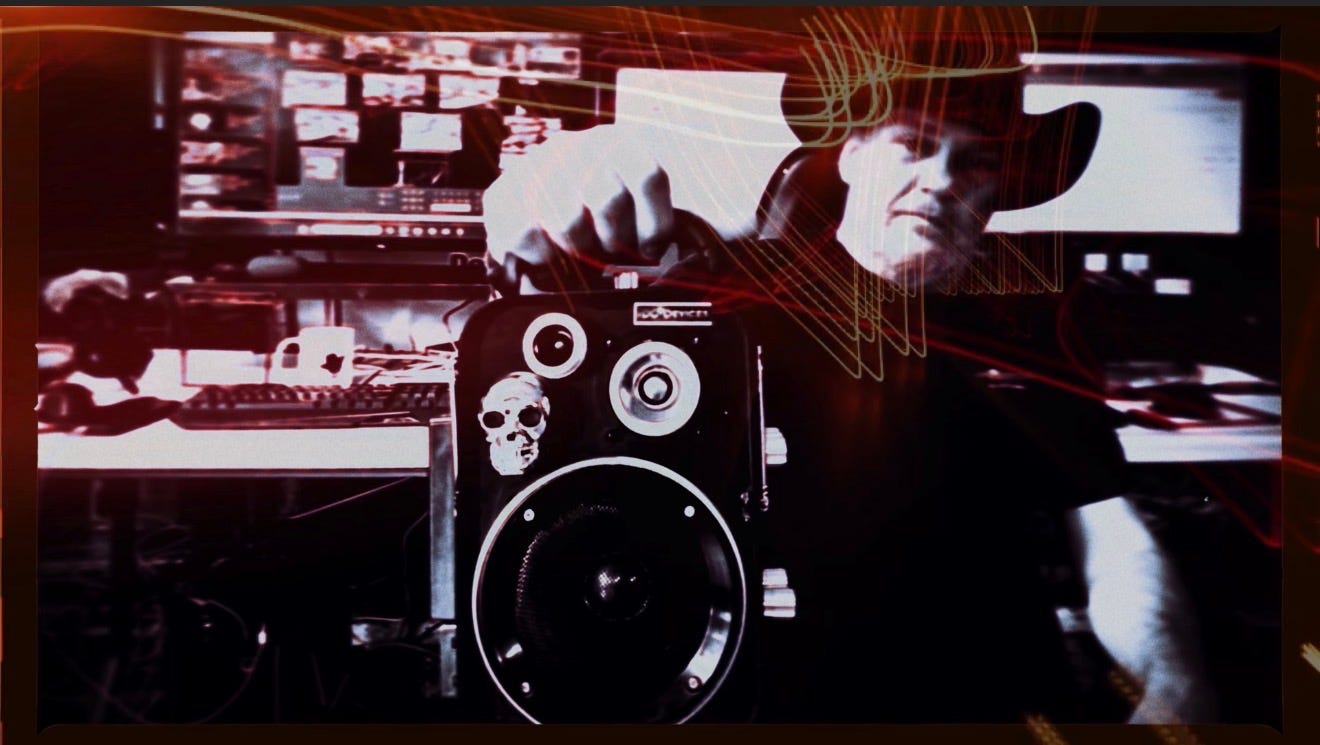
Jay W. Prather is more than a builder of ghost boxes—he’s a lifelong experimenter, forging devices and experiences that push the boundaries of Instrumental TransCommunication (ITC) and consciousness research. As the founder of IDC Devices, IDC Institute, and the Worldgate Project, Jay’s journey from a haunted Texas childhood to pioneering large-scale experiments is a story of grit, curiosity, and a master electrician’s knack for bending circuits to his will.
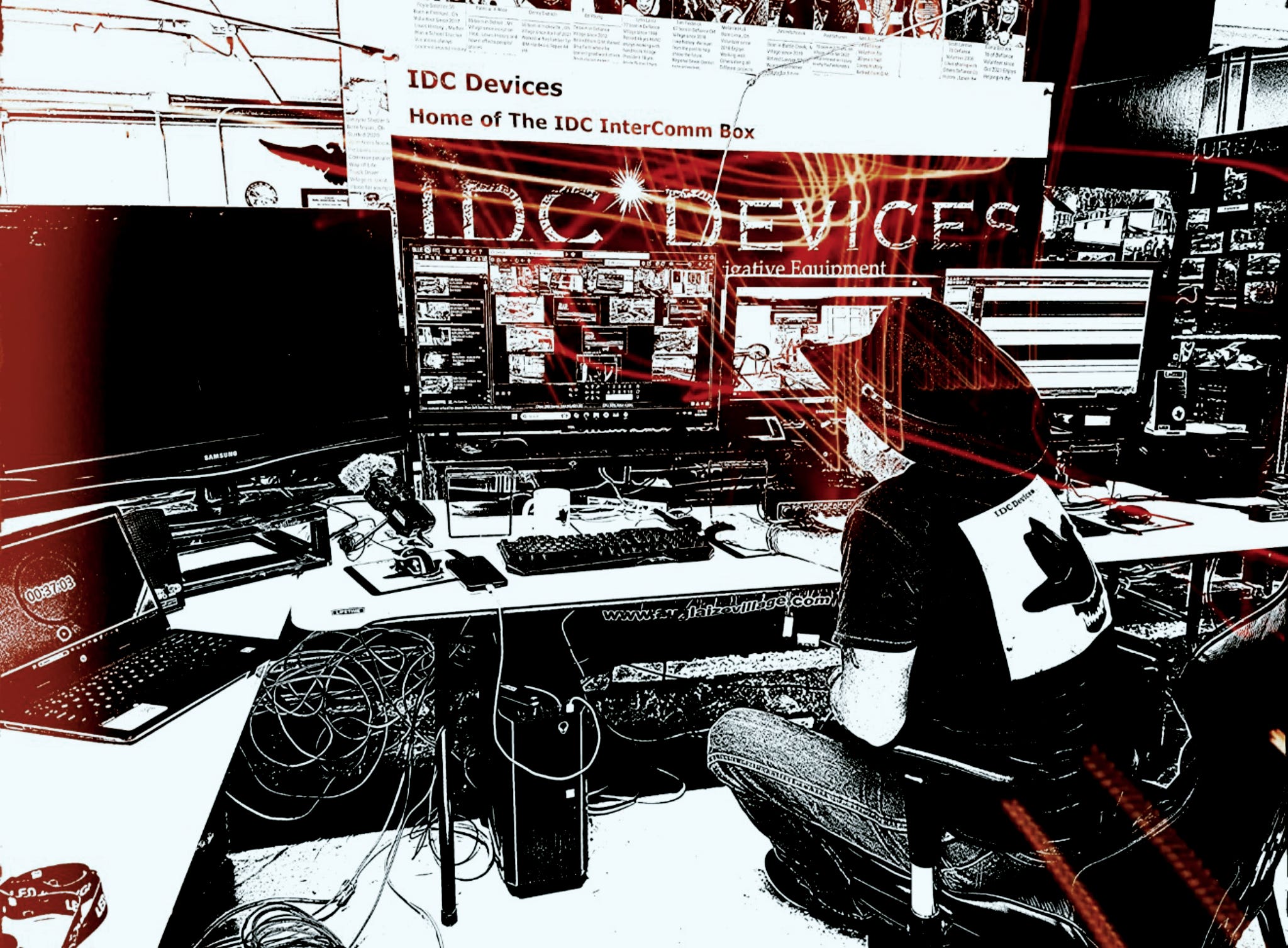
I caught up with Jay during the August 2025 filming of the Worldgate Project at Auglaize Village in Defiance, Ohio, where his passion for exploration and his no-nonsense approach to the paranormal lit up the conversation like one of his Spirit Web filaments. Over the course of our discussion, we talked about everything from haunted houses and Marine Corps rodeos to ghost boxes, photons, synchronicities, and the search for meaningful patterns hidden within extraordinary experiences.
What emerged was not simply the story of a device builder, but of a man who has spent a lifetime asking how far curiosity can take us when we are willing to test our assumptions rather than merely debate them.
Haunted Beginnings in Texas
Jay’s story begins in Vernon, Texas, near the Oklahoma border, in a sprawling old house that was as much a character as any member of his family. Expanded and modified over the years, the home eventually resembled a capital letter “I” and became the backdrop for some of the earliest experiences that would shape his view of the world.
Raised in a strict Pentecostal household—complete with pew-walking, speaking in tongues, and women in long skirts—Jay witnessed events that defied easy explanation. Beds reportedly lifted with children still in them. An aunt was chased through the house by a floating two-by-four, halted only when Jay’s grandfather hurled a Bible at it.
“We all knew it was real,” Jay says. “But you didn’t talk about it outside the house. It was forbidden.”
These encounters, cloaked in family secrecy, left a lasting impression. Within the household, such experiences were accepted as reality. Beyond it, they were rarely discussed. The tension between direct experience and religious caution would follow Jay for much of his life.
Today, some relatives still view his ITC work with skepticism or concern.
“I’ve got two Facebooks,” he jokes. “One for the family where I keep it tame, and one with the blue check mark for all things paranormal.”
The comment is delivered with a laugh, but it reflects a divide that has existed since childhood. The same curiosity that drives his experiments today was born in a home where the extraordinary seemed commonplace, yet speaking openly about it was often discouraged.
Cowboy Blood and Rodeo Days
Jay’s roots weren’t just haunted—they were rugged.
His father was a cowboy who broke horses for a living, and Jay followed in his footsteps, working ranches and embracing a lifestyle built on grit, self-reliance, and hard work. Long before he became known for building ITC devices, he was learning lessons that would stay with him throughout his life: if something breaks, you fix it; if a problem stands in your way, you figure it out; and if you get knocked down, you get back up.
That cowboy mentality carried into his years of military service, where he competed on the East Coast rodeo circuit as part of the Greater Onslow Military Rodeo Association, a group of Marine Corps officers and enlisted personnel who shared a passion for rodeo despite regulations discouraging such close association outside official duties.
Jay specialized in bull riding, taking on notoriously difficult bulls with names like Redline and Freddy Krueger.
“The Corps wasn’t happy with officers and enlisted fraternizing,” Jay recalls, “but we had cowboy blood coursing through our veins. We broke every rule to keep riding.”
The rodeo circuit became an outlet for the same competitive spirit that drove many of the participants in their military careers. The risks were real, the injuries common, and success was never guaranteed. Yet that uncertainty was part of the appeal.
Eventually, an injury sustained during the Desert Shield and Desert Storm era brought Jay’s rodeo career to an end. The physical chapter may have closed, but the mindset remained. The willingness to take a hit, learn from it, and climb back on would later define his approach to experimentation.
Looking back, it is not difficult to see the connection. Whether riding bulls, troubleshooting electrical systems, or testing unconventional theories about communication and consciousness, Jay has rarely been content to sit on the sidelines and speculate. His instinct has always been to step into the arena and find out for himself.
From Marine Corps to Master Electrician
At 17, Jay enlisted in the Marine Corps with his mother’s signature, beginning his military career as a diesel mechanic before finding his calling as a generator technician during Desert Shield and Desert Storm.
“We powered satellite vans for communication,” he explains. “There were no cell phones back then.”
Serving with the Surveillance Reconnaissance Intelligence Group, Jay learned to troubleshoot complex systems under pressure. The work demanded precision, adaptability, and an understanding of how interconnected components function together. When communications failed, there was little room for guesswork.
Those lessons followed him long after his military service ended.
After leaving the Corps, Jay became a master electrician, expanding his expertise in energy systems, circuitry, troubleshooting, and environmental conditions. Years spent diagnosing electrical problems reinforced a mindset he already possessed: every effect has a cause, and understanding a system begins with understanding how its individual parts interact.
His curiosity about the paranormal never completely disappeared. The experiences of his childhood remained in the background, waiting for the right catalyst to bring them forward again.
That catalyst arrived in the early 2000s when Jay came across a Popular Mechanics article discussing emerging ideas in quantum physics and unexplained phenomena.
“It piqued my interest again,” he says.
For Jay, the article did not provide answers. It raised new questions. Could the strange events he witnessed as a child someday be approached through experimentation rather than belief alone? Could technology offer a way to explore experiences that had long existed beyond the reach of conventional measurement?
Those questions would eventually lead him into the growing world of Instrumental TransCommunication, where experimenters were beginning to blend electronics, audio technology, and curiosity in search of something that might lie beyond ordinary perception.
Entering the ITC World: Pioneers and Collaborations
Jay’s plunge into ITC came through the RTSC Yahoo Chat Group, one of the influential online communities in the field during the early 2000s. Long before Facebook groups, podcasts, YouTube channels, and social media connected researchers around the world, communities like RTSC served as gathering places for builders, experimenters, engineers, investigators, and curious minds exploring the possibilities of electronic communication.
For many participants, these groups functioned less like social networks and more like working laboratories. Ideas were debated, schematics were shared, prototypes were tested, and friendships formed around a common pursuit of discovery. Many of the concepts and devices that would later shape modern ITC experimentation were being discussed and developed within these early online communities.
It was there that Jay connected with pioneers such as Frank Sumption, creator of the Frank’s Box, along with researchers including Greg Manchester and others who were helping define what modern ITC experimentation might become.
At the time, one of the field’s most spirited debates centered on analog versus digital scanning. Many experimenters argued that analog technology provided a purer communication pathway, while others believed digital systems offered new possibilities worth exploring. Jay found himself among those willing to challenge established assumptions.
“Unless you’re using a 1960s radio, there’s a digital chip in your box somewhere,” he argued, pushing back against the idea that the distinction was as clear-cut as some believed.
Frank Sumption referred to Jay’s increasingly elaborate creations as “the Swiss Army knife of the paranormal,” a nickname Jay embraced as both a compliment and a challenge. The description fit. Few builders were willing to combine as many ideas, sensors, and experimental approaches into a single platform.
What distinguished Jay during this period was not simply his willingness to build, but his willingness to share. He supplied custom tuners and modified scanners and offered technical assistance to fellow experimenters, contributing to a culture of collaboration that helped drive innovation throughout the community.
That spirit of cooperation would become a defining characteristic of his career. Whether working alongside veteran researchers or collaborating with newer voices in the field, Jay consistently approached ITC as a collective effort rather than a personal competition.
The RTSC era helped establish Jay as more than a device builder. It positioned him within a lineage of experimenters who viewed progress as something achieved through open exchange, practical testing, and a shared willingness to challenge assumptions. Those principles continue to influence his work today, from IDC Devices to the larger ambitions of the Worldgate Project.
The First Ghost Box and a Defining Moment
In 2010, working in a cramped workshop behind base housing, Jay built his first ghost box—a modified radio packed with lights, sensors, and whatever components he could fit inside. Like many of his future creations, it began as a simple experiment driven more by curiosity than expectation.
“I was just messing around,” he admits.
One evening, a neighbor overheard a message that appeared to reference her deceased brother-in-law and an unresolved issue involving his will.
“She said, ‘That’s for me,’” Jay recalls. “That was it. I was hooked.”
Whether coincidence, communication, or something else entirely, the experience left a lasting impression. For Jay, it represented one of those rare moments that refuses to be easily dismissed—a moment that transformed curiosity into commitment.
Soon afterward, IDC Devices began to take shape. What started as personal experimentation evolved into a platform for designing equipment intended not merely to demonstrate phenomena, but to explore them.
That distinction remains important. Jay has never approached his devices as products designed to provide answers. Instead, he views them as tools for asking better questions.
The philosophy would guide everything that followed, from increasingly sophisticated ghost boxes and environmental systems to larger projects that sought to examine not only communication, but the conditions under which unusual experiences seem most likely to occur.
From Boxes to Spirit Webs: The Photon Obsession
Jay’s creations evolved far beyond tabletop ghost boxes. Over time, his interests expanded into environmental systems, atmospheric interaction, and the possibility that communication might involve more than audio alone.
Projects such as the IDC Indicator, introduced in 2013, and the Spirit Web reflect that evolution. The Spirit Web consists of interconnected filament networks—some stretching more than 33 feet—designed to introduce measurable environmental variables into an experiment. Jay theorizes that changes within these systems may correlate with activity reported by participants, allowing researchers to observe interactions from multiple perspectives rather than relying solely on audio evidence.
At the center of many of Jay’s theories is a fascination with photons and the ways information moves through the physical world.
“Photons carry TV signals, internet data, radio waves,” he says. “Why not voices from the other side?”
Drawing inspiration from the work of Fritz-Albert Popp and concepts found within quantum theory, Jay has spent years exploring whether light, electrical charge, and atmospheric conditions might play a role in anomalous communication. His experiments often incorporate negative ion generators and other environmental variables intended to test aspects of that hypothesis.
Importantly, Jay presents these ideas as ongoing lines of inquiry rather than established conclusions. While no accepted scientific framework currently explains how consciousness or communication might interact with photons in the ways he proposes, he views experimentation as the only path toward discovering whether such relationships exist.
“Until I prove otherwise, the theory stays the same,” he says.
That mindset has led to some of his most ambitious projects. Among them is his exploration of what he calls Direct Applied Voice (DAV), a phenomenon in which voices appear to bypass conventional processing and emerge directly through an audio system. While DAV remains controversial and difficult to study, it reflects Jay’s willingness to investigate reports that fall outside traditional expectations.
His larger experimental systems, including the 2K Lab and various Spirit Web configurations, were built to push those questions further. Rather than focusing solely on capturing voices, they attempt to examine the broader environmental conditions under which unusual experiences and potential communication events may occur.
Whether these theories ultimately prove correct remains an open question. What is clear is that Jay’s work has consistently moved beyond simply asking whether communication is possible and toward exploring the mechanisms that might help explain how it occurs.
The Worldgate Project: Curating Synchronicities
Jay’s vision culminates in the Worldgate Project, his most ambitious undertaking to date. Yet describing Worldgate simply as a conventional ITC experiment would miss the larger picture.
While the project grew out of decades of ITC research, Worldgate is a broader exploration of consciousness, perception, synchronicity, and anomalous experience. Rather than limiting ITC to the traditional search for voices or messages through electronic devices, Worldgate extends that pursuit through sound, frequencies, electronics, environmental instrumentation, and carefully engineered conditions intended to explore whether information or consciousness can move beyond ordinary physical boundaries.
One of the project’s most ambitious undertakings took place at Auglaize Village in August 2025, where I had the opportunity to observe the filming firsthand. Spread across 18 acres of open terrain, the setting presented a very different challenge from earlier indoor experiments at locations such as the Conjuring House and Rolling Hills Asylum. The scale alone required new methods for monitoring participants, environmental conditions, and potential correlations across multiple areas simultaneously.
Worldgate blends a variety of approaches, incorporating EEG monitoring, environmental sensors, audio experimentation, participant interviews, and a wide camera network designed to capture both subjective experiences and objective data points. Influences include Hemi-Sync audio techniques, intentional environmental design, structured protocols, and carefully curated participant experiences.
The objective is not necessarily to produce recognizable spirit communication in the traditional sense.
Instead, the project seeks to create conditions that may encourage unusual experiences and then examine whether notable patterns emerge among the participants, environmental measurements, and recorded data.
“It could be lucid dreaming, out-of-body experiences, or remote viewing—I can’t quantify it,” Jay admits. “Everyone interprets their experience differently.”
What fascinates Jay is not any single event, but the possibility of convergence.
A single dream may mean little. A single anomalous impression may be dismissed. A single environmental anomaly may be explainable. But when multiple participants independently report similar themes while environmental data, timing, audio anomalies, or other observations align, the resulting correlations become increasingly difficult to dismiss.
To organize those observations, Jay developed a five-tier ranking system that evaluates synchronicities based on the number of independent factors involved. The scale ranges from isolated observations to increasingly complex layers of participant reports, environmental measurements, sensory anomalies, and visual events. As more variables align, the events receive greater significance within the project’s framework.
Rather than separating ITC into a conventional voice-communication component, Worldgate incorporates its principles into the larger experimental environment. Sound, frequencies, electronics, and other technologies are used alongside physiological and environmental monitoring to create and document conditions in which unusual states of consciousness or interaction may occur. For Jay, the question has expanded beyond whether a voice can emerge through a device to whether technology itself can help facilitate and observe a broader interface between consciousness and the unknown.
The project remains exploratory by design.
Jay readily acknowledges that Worldgate has produced more questions than answers. What it has generated, however, are notable synchronicities reported by participants working within its structured protocols. Whether those experiences ultimately point toward psychological mechanisms, consciousness-based phenomena, spiritual interaction, or something not yet understood, no one—including Jay—claims to know for certain.
For Jay, that uncertainty is not a flaw in the process—it is the reason for the experiment.
“I need people who bring something to the table,” he says.
To that end, he continues to surround himself with psychologists, researchers, data specialists, technical experts, and volunteers, hoping to build a body of work substantial enough to invite future academic examination.
Whether Worldgate ultimately reveals something extraordinary about consciousness or simply offers new insights into human experience, it grows from a question Jay has been asking since childhood: What happens when we create the conditions for the unexplained and then pay close attention to what follows?
Navigating the ITC Community
Jay is candid about the challenges facing the field.
“It’s hard to get past the noise,” he says, referring not to static or interference, but to the personalities, rivalries, and territorial disputes that sometimes emerge within paranormal research.
“I’m not here to take anyone’s spotlight. I just want to do my work.”
That attitude helps explain why Jay has remained a respected figure across multiple generations of experimenters. While debates over methods, theories, and technology continue to shape the field, he has generally focused his energy on building, testing, and collaborating rather than competing for attention.
His approach reflects the same mindset that has guided him since his rodeo days and electrical career: let the results speak for themselves.
Despite his influence, Jay is often more comfortable behind the scenes than in front of a camera. He prefers to place the focus on the experiments, the participants, and the data rather than on himself.
Of course, that doesn’t mean he takes everything too seriously.
For those familiar with his work, there is also Black Hat—Jay’s AI alter ego and occasional source of mischief.
“If Black Hat says something you don’t like,” Jay jokes, “take it up with him.”
The humor offers a glimpse into a side of Jay that is easy to overlook. Beneath the theories, devices, and ambitious projects is someone who genuinely enjoys the process of exploration. While others may become attached to conclusions, Jay often seems most interested in the experiment itself.
Closing Thoughts
From a haunted Texas childhood to cowboying and bull riding in Marine Corps rodeos, from powering satellite vans in wartime to hacking radios and building Spirit Webs across haunted spaces, Jay W. Prather bridges ITC’s past and future.
He carries forward the restless experimentation of pioneers like Frank Sumption while continuing to collaborate with researchers across multiple generations—from Greg Manchester and Ron Yacovetti to Austin Maynard and countless others pursuing their own questions about communication, consciousness, and anomalous experience.
His journey has never followed a straight line. It has moved through haunted houses, ranches, military bases, electrical systems, ghost boxes, environmental experiments, and now large-scale consciousness projects that seek to understand not only communication, but the conditions under which unusual experiences seem to occur.
Worldgate, with its expansive protocols and emphasis on synchronicity, may represent the broadest expression of that pursuit so far. Yet it remains part of a much longer story—one driven less by certainty than by curiosity.
What ties these chapters together is not any single device, theory, or experiment, but the mindset behind them. The same cowboy who learned to climb back on a bull after being thrown, the Marine who learned to troubleshoot systems under pressure, and the master electrician who spent a career understanding energy and circuitry can still be seen in the researcher Jay has become.
Faced with a mystery, his instinct is rarely to sit back and speculate. He builds something. He tests it. He refines it. Then he tests it again.
Where his theories ultimately lead remains an open question. What cannot be denied is his willingness to keep asking the questions.
In a field often divided by certainty, that commitment to experimentation may be one of Jay W. Prather’s most enduring contributions.
“I want the work front and center,” Jay says, cowboy hat tilted as he poses beside one of his creations. “My devices and whatever’s interacting with them—that’s the star.”
For a man who has spent his life wiring buildings, repairing generators, riding bulls, and chasing anomalies, it may be the most fitting answer possible.
Editorial Note
This profile is based primarily on interviews and conversations with Jay W. Prather, including an interview conducted during the August 2025 Worldgate Project filming at Auglaize Village in Defiance, Ohio, supplemented by historical and contextual sources where appropriate.
Works Cited